“FAST & FURIOUS” Revelations Squashed: First Amendment Rights Violated. What Are Obama & Goons Hiding? Commentary By Adina Kutnicki

There are so many illegal actions swirling overhead on Capitol Hill it is nigh impossible to keep abreast, even if one is as tuned in as this blogger tends to be. Invariably, some poopings will fall through the cracks, yet it is not for lack of effort or relevant access.

Be that as it may, several remain a focal point, most intrinsically: Benghazigate, IRSgate, NSAgate, DOJgate as well as Fast & Furious. But before we catch up with one in particular it is instructive to take note of the following: if there is no “there there”, then surely opening up “this and that” to the public – and subjecting its aftermath to the light of day – should be warranted and certainly not hushed up. You think? Yet, if the opposite is the case, to hell with the First Amendment, and hiding under the guise of “security” and other made up out of whole cloth concerns suddenly becomes a mitigating factor. Give us all a break…so many tall tales…who can keep up!

Indeed, freedom of religion (NOT including the jihadist kind) and freedom of expression (but screaming fire in a crowded auditorium, for example, is hardly “protected” expression/speech) is sacrosanct, at least it is supposed to be in America. As such, some who retire from security-related posts are inclined to pen their memoirs, even though they are usually vetted by their former employers/superiors. No problem with that.

To be sure, no one at this site is suggesting that national security isn’t a critical concern, however, pointing out a program which ACTUALLY endangers U.S. interests – for whatever reason – must be fair game. If not, some who harbor less than an American agenda will continue as is and many citizens will be at risk. Well, in third world countries silencing whistle blowers is the norm, but is it the “new” normal in America? Hope not. Which leads us back to Fast & Furious and the censorship fight ahead.

ATF tries to block whistleblowing agent’s Fast and Furious book

1st Amendment battle over ‘gun-walking’ expose

The Bureau of Alcohol, Tobacco, Firearms and Explosives is blocking the main whistleblower in the Fast and Furious case from publishing a book for pay, claiming his retelling of the Mexico “gun-walking” scandal will hurt morale inside the embattled law enforcement agency, according to documents obtained by The Washington Times.

ATF’s dispute with Special Agent John Dodson is setting up a First Amendment showdown that is poised to bring together liberal groups like the American Civil Liberties Union and conservatives in Congress who have championed Mr. Dodson’s protection as a whistleblower.

The ACLU is slated to become involved in the case Monday, informing ATF it is representing Mr. Dodson and filing a formal protest to the decision to reject his request to publish the already written book, sources told The Times, speaking only on the condition of anonymity.

The battle also could have repercussions on Capitol Hill, where the two lead investigators who helped uncover the Fast and Furious scandal, Sen. Chuck Grassley, Iowa Republican, and House Oversight and Government Reform Committee Chairman Darrell E. Issa, Calif. Republican, had written a foreword to the book, the sources said.

ATF officials declined Sunday night to discuss Mr. Dodson’s specific matter, citing personnel privacy. But the officials said it was possible for an agent to be rejected for publishing a book for pay but get permission to publish it for free. No manuscript for any Fast and Furious book has received approval for unpaid publication, however, the officials said.

Mr. Dodson was the first ATF special agent to go public in 2011 with allegations that his supervisors had authorized the flow of semi-automatic weapons into Mexico instead of interdicting them, touching off a scandal that toppled most of the top leadership of ATF in Washington and Phoenix. The controversy also led to angry recriminations in Mexico, which dealt with a wave of violent crime linked to the weapons, and high-profile congressional hearings that embarrassed the Obama administration.

Mr. Dodson began penning a book late last year about his role as the central whistleblower in the case and in June sought formal permission for outside employment that would allow him to engage a publisher and publish the book.

Documents show that one of Mr. Dodson’s supervisors in Arizona, Assistant Special Agent in Charge Carlos Canino, rejected his request July 19 and was backed in the decision by the agent in charge of the office, Thomas G. Atteberry, four days later.

Their rejection made no claims that the book would release sensitive or classified information or compromise ongoing law enforcement proceedings.

Rather, the supervisors offered a different reason for their decision. “This would have a negative impact on morale in the Phoenix [Field Division] and would have a detrimental effect on our relationships with DEA and FBI.”

The ATF general counsel’s office subsequently sanctioned the decision, all but killing the book project.

“An employee’s supervisory chain may disapprove any outside employment request for any reason, at any supervisory level,” ATF attorney Greg Serres wrote Mr. Dodson on Aug. 29, underlining the word “any” for emphasis. “The Office of Chief Counsel cannot approve outside employment requests in lieu of the supervisory chain’s disapproval.

“Therefore, your request to engage in outside employment is denied,” he said.

Separately, a top ATF official has been reviewing Mr. Dodson’s manuscript for any concerns about sensitive or classified information, potentially leaving open the possibility a process by which it could be published for free, a senior law enforcement official told The Times.

The gun-walking strategy — part of an undercover case called Fast and Furious — violated ATF’s long-standing policy to interdict weapons from straw buyers.

In all, ATF officials permitted more than 1,700 semi-automatic weapons to flow through the hands of straw buyers for the Mexican cartels, with many crossing the border.

Senior ATF officials hoped to trace the guns to crimes, then make a bigger case against the Mexican drug lords. The strategy, however, backfired when hundreds of the weapons began showing up at crime scenes on both sides of the border, including at the December 2010 murder of U.S. Border Patrol Agent Brian Terry.

The Justice Department initially denied guns knowingly had been allowed to flow across the border, then months later reversed course and admitted the tactic had been used for more than a year. The change in story led to allegations of a cover-up.

The revelations exploded into public in spring 2011, catapulting Mr. Dodson and other ATF field agents who had objected into dual investigations by Congress and the Justice Department inspector general.

President Obama and Attorney General Eric H. Holder Jr. both claimed they knew nothing about the strategy until the controversy erupted, but the president has invoked executive privilege to block Congress from seeing certain documents, thus thwarting the completion of that probe. A court recently ruled in favor of Congress in the ongoing legal dispute.

Both the congressional and inspector general investigations concluded that the gun-walking tactics were poorly conceived and put lives in jeopardy. The fallout forced the ouster of numerous top officials, including the U.S. attorney in Phoenix, Dennis Burke, and the acting director of the ATF, Kenneth Melson.

The ATF, under new director B. Todd Jones, says it has imposed sweeping procedures to ensure gun-walking doesn’t occur in future cases.

The book dispute with Mr. Dodson, however, is not the first First Amendment controversy to erupt in the aftermath of the scandal.

Last year, Mr. Jones raised alarm in Congress and inside his own agency when he released a videotaped message that warned agencies that there would be “consequences” if agents blew the whistle on wrongdoing outside their chain of command.

The message led to claims that whistleblowing would be chilled, and ATF subsequently clarified Mr. Jones‘ remarks to emphasize that the agency would not interfere with legitimate whistleblowing activities.

Patriots are receiving blows from both ends, sort of like a double-barreled shotgun. On the one hand, a hammer effect is chipping away at one freedom after another. This is no longer debatable, it is fact-based. On the flip side, those who are tasked to protect citizens’ rights are doing no such thing. Consider the detrimental, runaway results from AG Holder’s fiefdom, and then juxtapose them against the military-style gearing up of police forces.

Does it appear that there is any official entity a citizen-patriot can reliably count on? Not from this laser-focused patriot’s lens.

The NSA: Caught, Dead To Rights…Commentary By Adina Kutnicki

From the get go, be rest assured, this blog makes no pretense in pretending to understand anything which necessitates computer-based expertise. Such a claim would be more than a hoot…can even hear some nearest and dearest emitting quite a few chuckles, as this is being written. Indeed, this science/math based specialty is best left in the capable hands of software/hardware engineers – you know who you are – as they sift through all the highly technical mumbo jumbo aspects of the NSA. It is the most advanced, illegal (domestically-speaking) spying system in the world. Most intrinsically, outside efforts (hack-wise or not…whatever it takes…beating NSA’s spies at their own game, as they dare pry, EN MASSE, into the privacy of Americans) to uncover the manifest abuses conducted under the purview of Obama Inc. may very well save the greatest Constitutional Republic in the world. Get cracking. Cat and mouse.

Nevertheless, the expertise herein absolutely lies in geo-politics, Islamic jihad and the Mid East, including its politics, religion and culture. And it doesn’t take a computer scientist to wade through the non-technical muck, in turn, internalizing what constitutes unfettered spying. This is for sure.

To be exact, when one is immersed in the dogged pursuit of those who dare to mess with liberty and freedom – chiefly, creatures belonging to the red/green alliance – anything smacking of squelching said freedoms, well, it doesn’t go unnoticed or non- pursued.

In this regard, in tandem with all the explosive scandals due to Obama Inc., including NSAgateas well as IRSgate, Benghazigate, DOJgate, Fast & Furious, etc, the notion that any move a U.S. citizen makes is open to monitoring, well, few Americans are okay with living in a police statejust ask the Catalanos (Michele Catalano, a long time blogger at PJ Media and elsewhere…holy smokes) and countless others, whose homes were invaded, all for the ‘crime’ of internet searches! In fact, being that this blogger’s searches covers a gambit of hot range issues…burning up the long distance telephone wires in the process…can’t imagine how dangerous it would be to still live in the U.S. And this (very disturbing) sentiment is coming from someone who lives within missile range of Al Qaeda, Hezbollah, Hamas and many other jihadi terrorist groups! No kidding.

Most egregiously, the exception to their blanket spying is the Muslim American community, and their ‘hands off’ policy is evinced herein – Homeland Insecurity: The White House assures that tracking our every phone call and keystroke is to stop terrorists, and yet it won’t snoop in mosques, where the terrorists are.

That’s right, the government’s sweeping surveillance of our most private communications excludes the jihad factories where homegrown terrorists are radicalized.

Since October 2011, mosques have been off-limits to FBI agents. No more surveillance or undercover string operations without high-level approval from a special oversight body at the Justice Department dubbed the Sensitive Operations Review Committee.

Who makes up this body, and how do they decide requests? Nobody knows; the names of the chairman, members and staff are kept secret.

We do know the panel was set up under pressure from Islamist groups who complained about FBI stings at mosques. Just months before the panel’s formation, the Council on American-Islamic Relations teamed up with the ACLU to sue the FBI for allegedly violating the civil rights of Muslims in Los Angeles by hiring an undercover agent to infiltrate and monitor mosques there.”

IF Obama and gang truly believe that domestic spying on ALL Americans, yet excluding those who are the gravest threat – Muslim Americans – is going to pass muster, well, it is doubtful that patriots will continue to stand still.

XKeyscore: NSA tool collects ‘nearly everything a user does on the internet’

• XKeyscore gives ‘widest-reaching’ collection of online data
• NSA analysts require no prior authorization for searches
• Sweeps up emails, social media activity and browsing history
• NSA’s XKeyscore program – read one of the presentations

XKeyscore map
One presentation claims the XKeyscore program covers ‘nearly everything a typical user does on the internet’

A top secret National Security Agency program allows analysts to search with no prior authorization through vast databases containing emails, online chats and the browsing histories of millions of individuals, according to documents provided by whistleblower Edward Snowden.

The NSA boasts in training materials that the program, called XKeyscore, is its “widest-reaching” system for developing intelligence from theinternet.

The latest revelations will add to the intense public and congressional debate around the extent of NSA surveillance programs. They come as senior intelligence officials testify to the Senate judiciary committee on Wednesday, releasing classified documents in response to the Guardian’s earlier stories on bulk collection of phone records and Fisasurveillance court oversight.

The files shed light on one of Snowden’s most controversial statements, made in his first video interview published by the Guardian on June 10.

“I, sitting at my desk,” said Snowden, could “wiretap anyone, from you or your accountant, to a federal judge or even the president, if I had a personal email”.

US officials vehemently denied this specific claim. Mike Rogers, the Republican chairman of the House intelligence committee, said of Snowden’s assertion: “He’s lying. It’s impossible for him to do what he was saying he could do.”

But training materials for XKeyscore detail how analysts can use it and other systems to mine enormous agency databases by filling in a simple on-screen form giving only a broad justification for the search. The request is not reviewed by a court or any NSA personnel before it is processed.

XKeyscore, the documents boast, is the NSA’s “widest reaching” system developing intelligence from computer networks – what the agency calls Digital Network Intelligence (DNI). One presentation claims the program covers “nearly everything a typical user does on the internet”, including the content of emails, websites visited and searches, as well as theirmetadata.

Analysts can also use XKeyscore and other NSA systems to obtain ongoing “real-time” interception of an individual’s internet activity.

Under US law, the NSA is required to obtain an individualized Fisawarrant only if the target of their surveillance is a ‘US person’, though no such warrant is required for intercepting the communications of Americans with foreign targets. But XKeyscore provides the technological capability, if not the legal authority, to target even US persons for extensive electronic surveillance without a warrant provided that some identifying information, such as their email or IP address, is known to the analyst.

One training slide illustrates the digital activity constantly being collected by XKeyscore and the analyst’s ability to query the databases at any time.

KS1

The purpose of XKeyscore is to allow analysts to search the metadata as well as the content of emails and other internet activity, such as browser history, even when there is no known email account (a “selector” in NSAparlance) associated with the individual being targeted.

Analysts can also search by name, telephone number, IP address, keywords, the language in which the internet activity was conducted or the type of browser used.

One document notes that this is because “strong selection [search by email address] itself gives us only a very limited capability” because “a large amount of time spent on the web is performing actions that are anonymous.”

The NSA documents assert that by 2008, 300 terrorists had been captured using intelligence from XKeyscore.

Analysts are warned that searching the full database for content will yield too many results to sift through. Instead they are advised to use themetadata also stored in the databases to narrow down what to review.

A slide entitled “plug-ins” in a December 2012 document describes the various fields of information that can be searched. It includes “every email address seen in a session by both username and domain”, “every phone number seen in a session (eg address book entries or signature block)” and user activity – “the webmail and chat activity to include username, buddylist, machine specific cookies etc”.

Email monitoring

In a second Guardian interview in June, Snowden elaborated on his statement about being able to read any individual’s email if he had their email address. He said the claim was based in part on the email search capabilities of XKeyscore, which Snowden says he was authorized to use while working as a Booz Allen contractor for the NSA.

One top-secret document describes how the program “searches within bodies of emails, webpages and documents”, including the “To, From, CC, BCC lines” and the ‘Contact Us’ pages on websites”.

To search for emails, an analyst using XKS enters the individual’s email address into a simple online search form, along with the “justification” for the search and the time period for which the emails are sought.

KS2

KS3edit2

The analyst then selects which of those returned emails they want to read by opening them in NSA reading software.

The system is similar to the way in which NSA analysts generally can intercept the communications of anyone they select, including, as one NSA document put it, “communications that transit the United States and communications that terminate in the United States”.

One document, a top secret 2010 guide describing the training received by NSA analysts for general surveillance under the Fisa Amendments Act of 2008, explains that analysts can begin surveillance on anyone by clicking a few simple pull-down menus designed to provide both legal and targeting justifications. Once options on the pull-down menus are selected, their target is marked for electronic surveillance and the analyst is able to review the content of their communications:

KS4

Chats, browsing history and other internet activity

Beyond emails, the XKeyscore system allows analysts to monitor a virtually unlimited array of other internet activities, including those within social media.

An NSA tool called DNI Presenter, used to read the content of stored emails, also enables an analyst using XKeyscore to read the content of Facebook chats or private messages.

KS55edit

An analyst can monitor such Facebook chats by entering the Facebook user name and a date range into a simple search screen.

KS6

Analysts can search for internet browsing activities using a wide range of information, including search terms entered by the user or the websites viewed.

KS7

As one slide indicates, the ability to search HTTP activity by keyword permits the analyst access to what the NSA calls “nearly everything a typical user does on the internet”.

KS8

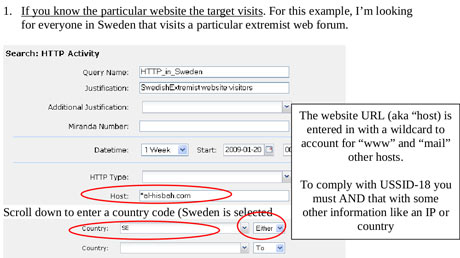
The XKeyscore program also allows an analyst to learn the IP addresses of every person who visits any website the analyst specifies.

KS9

The quantity of communications accessible through programs such as XKeyscore is staggeringly large. One NSA report from 2007 estimated that there were 850bn “call events” collected and stored in the NSA databases, and close to 150bn internet records. Each day, the document says, 1-2bn records were added.

William Binney, a former NSA mathematician, said last year that the agency had “assembled on the order of 20tn transactions about US citizens with other US citizens”, an estimate, he said, that “only was involving phone calls and emails”. A 2010 Washington Post article reported that “every day, collection systems at the [NSA] intercept and store 1.7bn emails, phone calls and other type of communications.”

The XKeyscore system is continuously collecting so much internet data that it can be stored only for short periods of time. Content remains on the system for only three to five days, while metadata is stored for 30 days. One document explains: “At some sites, the amount of data we receive per day (20+ terabytes) can only be stored for as little as 24 hours.”

To solve this problem, the NSA has created a multi-tiered system that allows analysts to store “interesting” content in other databases, such as one named Pinwale which can store material for up to five years.

It is the databases of XKeyscore, one document shows, that now contain the greatest amount of communications data collected by the NSA.

KS10

In 2012, there were at least 41 billion total records collected and stored in XKeyscore for a single 30-day period.

KS11

Legal v technical restrictions

While the Fisa Amendments Act of 2008 requires an individualized warrant for the targeting of US persons, NSA analysts are permitted to intercept the communications of such individuals without a warrant if they are in contact with one of the NSA’s foreign targets.

The ACLU’s deputy legal director, Jameel Jaffer, told the Guardian last month that national security officials expressly said that a primary purpose of the new law was to enable them to collect large amounts of Americans’ communications without individualized warrants.

“The government doesn’t need to ‘target’ Americans in order to collect huge volumes of their communications,” said Jaffer. “The government inevitably sweeps up the communications of many Americans” when targeting foreign nationals for surveillance.

An example is provided by one XKeyscore document showing an NSAtarget in Tehran communicating with people in Frankfurt, Amsterdam and New York.

KS12

In recent years, the NSA has attempted to segregate exclusively domestic US communications in separate databases. But even NSA documents acknowledge that such efforts are imperfect, as even purely domestic communications can travel on foreign systems, and NSA tools are sometimes unable to identify the national origins of communications.

Moreover, all communications between Americans and someone on foreign soil are included in the same databases as foreign-to-foreign communications, making them readily searchable without warrants.

Some searches conducted by NSA analysts are periodically reviewed by their supervisors within the NSA. “It’s very rare to be questioned on our searches,” Snowden told the Guardian in June, “and even when we are, it’s usually along the lines of: ‘let’s bulk up the justification’.”

In a letter this week to senator Ron Wyden, director of national intelligence James Clapper acknowledged that NSA analysts have exceeded even legal limits as interpreted by the NSA in domestic surveillance.

Acknowledging what he called “a number of compliance problems”, Clapper attributed them to “human error” or “highly sophisticated technology issues” rather than “bad faith”.

However, Wyden said on the Senate floor on Tuesday: “These violations are more serious than those stated by the intelligence community, and are troubling.”

In a statement to the Guardian, the NSA said: “NSA’s activities are focused and specifically deployed against – and only against – legitimate foreign intelligence targets in response to requirements that our leaders need for information necessary to protect our nation and its interests.

“XKeyscore is used as a part of NSA’s lawful foreign signals intelligence collection system.

“Allegations of widespread, unchecked analyst access to NSA collection data are simply not true. Access to XKeyscore, as well as all of NSA’s analytic tools, is limited to only those personnel who require access for their assigned tasks … In addition, there are multiple technical, manual and supervisory checks and balances within the system to prevent deliberate misuse from occurring.”

“Every search by an NSA analyst is fully auditable, to ensure that they are proper and within the law.

“These types of programs allow us to collect the information that enables us to perform our missions successfully – to defend the nation and to protect US and allied troops abroad.”

Are you dizzy yet? Hope not. After all, despite their spin that FULL frontal spying is mandatory to keep America safe (just ask Boston’s victims if they feel safer, knowing full well that the Chechen bombers WERE monitoredbut only once Russia’s security forces gave U.S. security the heads up…not due to anything the NSA uncovered) we know better. Certainly expect so.